Shenzhen Summit Fails to Deliver: Why the 'Yalta 2.0' Hype Fell Flat
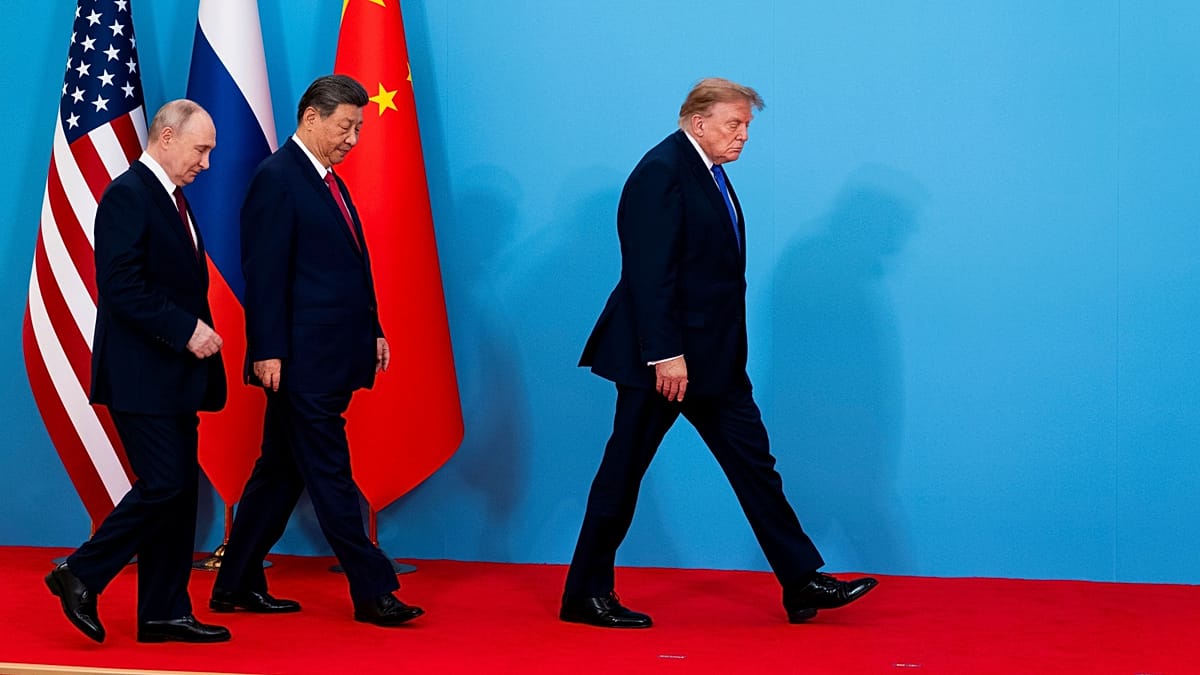
A high-profile trilateral summit in China featuring Donald Trump, Xi Jinping, and Vladimir Putin ended with scant substance, while European leaders in Berlin shrugged off the diplomatic spectacle.
 🌍World
Photo: Euronews
Key points
- The Shenzhen trilateral summit produced minimal substantive geopolitical agreements.
- Russia's agenda regarding Ukraine was omitted from the final joint statement.
- European leaders in Berlin rejected any attempts to redraw global spheres of influence.
Hype in international diplomacy carries inherent risks, and the heavily promoted trilateral meeting in China's technology hub of Shenzhen proved this point. Dubbed "Yalta 2.0" by optimists seeking parallels with the 1945 conference that carved up post-war spheres of influence, the gathering ultimately fell far short of expectations, yielding few concrete diplomatic outcomes.
For the US delegation, the primary takeaway appeared to be a routine photo opportunity and a broad joint declaration against nuclear warfare devoid of enforcement mechanisms. Meanwhile, Moscow's efforts to push its war in Ukraine to the forefront were conspicuously ignored, leaving the conflict entirely out of the final communique. Conversely, Chinese leadership leveraged the platform to project a confident alternative to the Western-led global architecture.
European capitals responded with a collective and calculated shrug. Coinciding with the Shenzhen talks, European leaders convened in Berlin within the Coalition of the Willing. German Chancellor Friedrich Merz and French President Emmanuel Macron firmly rejected any revival of a Yalta-style division of power, emphasizing that European nations retain full sovereignty over their political destiny.
Source Euronews — euronews.com/2026/11/21/off-the-record-europe-shrugs-as-trumps-yalt… ↗
Read next
 📈Business
Trump Administration Pressures Intel and Nvidia, Sparking Concerns Over State Control
Newly unsealed court documents reveal aggressive government pressure on Intel and Nvidia, shifting tech policy toward direct state stakes.
 🚀Space
Ukraine braces for another difficult winter amid ongoing attacks on energy infrastructure
Ukrainians are preparing for a harsh winter as continuous strikes on energy facilities and rising food prices strain households.
 🛡️Cyber
Russia’s hybrid war on Europe is evolving but failing to deter Ukraine support, IISS report says
A report by the IISS highlights an increase in Russian sabotage and infrastructure attacks across Europe, noting however that the strategy has failed to weaken support fo…
 🔬Science
Biomolecular analysis reveals centuries-old embalming recipes for Egyptian crocodile mummies
A study of ancient Egyptian crocodile mummies shows that embalmers used the exact same beeswax and pine resin recipe centuries apart at a single site.
 🛡️Cyber
Cybersecurity Weekly Roundup: Ransomware Fraud, ChatGPT Sites Leaks, and New Defenses
The latest threat intelligence roundup covers charges against a recovery firm co-founder, web app exposure risks, software patches, and VirusTotal's new detection feature…
 💻Tech
Astronomers Witness Rare Stellar Merger as Red Giant Devours Companion Star
An international team of researchers used advanced ground- and space-based telescopes to document a rare cosmic event where a massive red giant swallowed its smaller stel…