APEC Summit: US, Chinese and Russian Leaders Meet Amid Talks on AI and Global Security
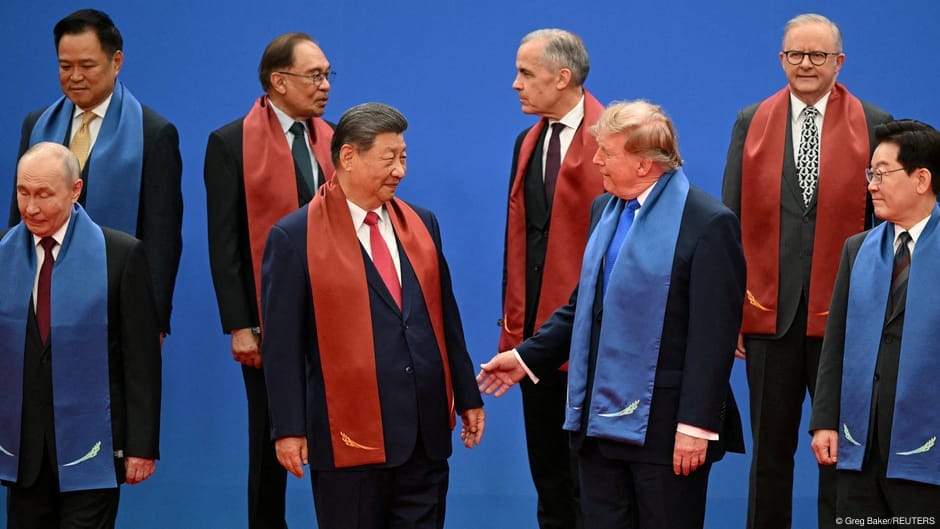
At the APEC summit in Shenzhen, Donald Trump, Xi Jinping, and Vladimir Putin held high-stakes bilateral meetings covering geopolitics, arms control, and technology regulation.
 🌍World
Photo: DW (EN)
Key points
- US and Chinese leaders met to discuss the stabilization of bilateral relations
- Donald Trump voiced staunch opposition to globalist regulation of artificial intelligence
- US and Russian presidents conferred on the war in Ukraine and strategic nuclear arsenals
On the sidelines of the Asia-Pacific Economic Cooperation (APEC) summit in Shenzhen, a series of high-profile meetings unfolded between leaders of the world's major powers. US President Donald Trump and Chinese leader Xi Jinping held discussions aimed at steering bilateral ties toward stability. According to the Chinese president, both nations have established a constructive framework based on mutual respect, fairness, and reciprocity. The leaders reportedly touched upon potential agricultural trade agreements as well as pressing international security challenges, including the conflicts in Ukraine and the Middle East.
Meanwhile, a 40-minute bilateral meeting between Donald Trump and Russian President Vladimir Putin drew considerable attention. The US leader described the interaction as a potential starting point for positive developments, although prior diplomatic efforts have yet to yield an end to the war in Ukraine. The two presidents also discussed upcoming trilateral talks and overall bilateral relations. In parallel, Japanese Prime Minister Sanae Такаiти engaged in a brief conversation with the Russian leader during a dinner reception, conveying Tokyo's stance on pending issues, including the detention of a Japanese journalist.
Technology Policy and Nuclear Arsenals
Addressing the APEC gathering, the US president delivered a firm stance on the future of digital innovation. Donald Trump emphasized that the United States firmly opposes any form of "globalist regulation" regarding artificial intelligence, utilizing the term "super intelligence" (SI) mandated by his administration. He stated that Washington will not permit any measures intended to control or stifle the advancement of these advanced systems.
Beyond technology, strategic weaponry remained a focal point of discussion. The US president highlighted existing nuclear stockpiles, noting that the United States holds approximately 4,000 nuclear weapons, Russia possesses 3,800, and China maintains a smaller but rapidly expanding arsenal. These developments highlight the complex intersection between geopolitical strategy, global security, and enterprise technology sectors.
Source DW (EN) — dw.com/en/apec-summit-putin-xi-meet-ahead-of-trilateral-talks-with-… ↗
Read next
 🚀Space
Ukraine braces for another difficult winter amid ongoing attacks on energy infrastructure
Ukrainians are preparing for a harsh winter as continuous strikes on energy facilities and rising food prices strain households.
 🛡️Cyber
Russia’s hybrid war on Europe is evolving but failing to deter Ukraine support, IISS report says
A report by the IISS highlights an increase in Russian sabotage and infrastructure attacks across Europe, noting however that the strategy has failed to weaken support fo…
 🔬Science
Biomolecular analysis reveals centuries-old embalming recipes for Egyptian crocodile mummies
A study of ancient Egyptian crocodile mummies shows that embalmers used the exact same beeswax and pine resin recipe centuries apart at a single site.
 🛡️Cyber
Cybersecurity Weekly Roundup: Ransomware Fraud, ChatGPT Sites Leaks, and New Defenses
The latest threat intelligence roundup covers charges against a recovery firm co-founder, web app exposure risks, software patches, and VirusTotal's new detection feature…
 💻Tech
Astronomers Witness Rare Stellar Merger as Red Giant Devours Companion Star
An international team of researchers used advanced ground- and space-based telescopes to document a rare cosmic event where a massive red giant swallowed its smaller stel…
 🔬Science
Bacterial colonies turn themselves inside out when oxygen is scarce
An international research team discovered that Neisseria gonorrhoeae bacteria respond to oxygen depletion in the colony's center by reducing cell adhesion, triggering a p…