Astronomers Witness the Final Stage of a Binary Star Merger for the First Time
Using the James Webb Space Telescope, researchers have captured the final moments of a common envelope evolution in a nearby galaxy, resulting in a luminous red nova.
 🚀Space
Photo: Universe Today
Key points
- First-ever observation of the final inspiral phase of a binary star merger
- JWST captured data just 47 days after the eruption peaked
- The merging process in the Andromeda system took only seven years
Binary star systems are common across the universe, but capturing their dramatic final moments has long eluded astrophysicists. Theoretical models have long described how binary stars can share a transitory common envelope of gas, creating a powerful frictional drag that forces the two stellar bodies to spiral inward. While this evolutionary stage is theoretically understood, actually observing the culmination of an inspiral and the resulting eruption in real time has remained an unprecedented challenge due to the rarity and unpredictability of these events.
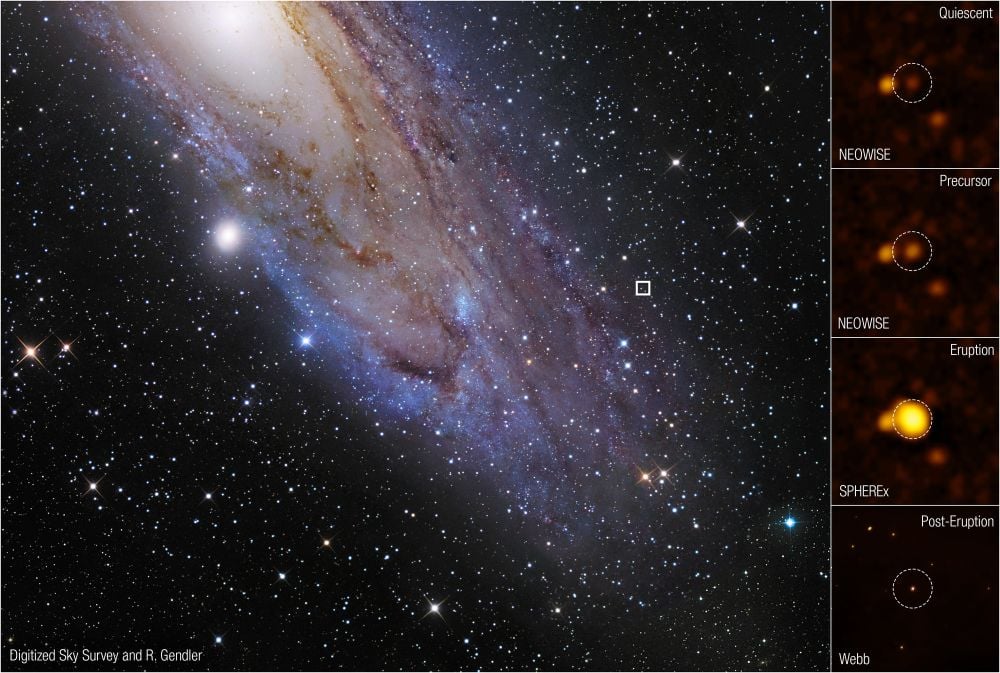
A breakthrough came with the detailed study of AT 2025abao, a transient eruption located in the neighboring Andromeda Galaxy. Tracked by astronomers since 2018 due to unusual brightness fluctuations, the system—affectionately dubbed 'Bao'—consisted of a puffy supergiant and a main-sequence star slightly less massive than the Sun. Unlike standard systems that take thousands of orbits to merge, this rare pair completed its inward spiral and merged in a mere seven orbits, spanning approximately seven years.
In 2025, the system erupted as a luminous red nova as the two stars completely coalesced. The James Webb Space Telescope observed Bao just 47 days after the eruption peaked, marking the earliest follow-up observation of such a stellar merger. This rapid response provided unprecedented data detailing the system's structure before, during, and immediately after the explosive event.
«Stellar mergers are very, very difficult to observe in real time because they are hard to predict,» stated lead author Viraj Karambelkar, a NASA Hubble Fellow at Columbia University. This landmark observation validates core astrophysical theories regarding common envelope evolution and offers a unique window into the violent processes shaping compact binary systems.
Source Universe Today — universetoday.com/articles/this-is-the-first-time-astronomers-have-… ↗
Read next
 🛡️Cyber
Russia’s hybrid war on Europe is evolving but failing to deter Ukraine support, IISS report says
A report by the IISS highlights an increase in Russian sabotage and infrastructure attacks across Europe, noting however that the strategy has failed to weaken support fo…
 🔬Science
Biomolecular analysis reveals centuries-old embalming recipes for Egyptian crocodile mummies
A study of ancient Egyptian crocodile mummies shows that embalmers used the exact same beeswax and pine resin recipe centuries apart at a single site.
 🛡️Cyber
Cybersecurity Weekly Roundup: Ransomware Fraud, ChatGPT Sites Leaks, and New Defenses
The latest threat intelligence roundup covers charges against a recovery firm co-founder, web app exposure risks, software patches, and VirusTotal's new detection feature…
 💻Tech
Astronomers Witness Rare Stellar Merger as Red Giant Devours Companion Star
An international team of researchers used advanced ground- and space-based telescopes to document a rare cosmic event where a massive red giant swallowed its smaller stel…
 🌍World
NATO Fighter Jets Scrambled After Drone Enters Latvian Airspace
Latvian armed forces deployed Alliance aircraft and interceptors following a brief border breach by an unidentified unmanned aerial vehicle.
 🔬Science
Bacterial colonies turn themselves inside out when oxygen is scarce
An international research team discovered that Neisseria gonorrhoeae bacteria respond to oxygen depletion in the colony's center by reducing cell adhesion, triggering a p…