Cosmic Speedometers: Sand Dunes Reveal Wind Speeds Across the Solar System
Stanford researchers discovered that the size of sand dunes and their grains can act as precise speedometers for winds on Earth and alien worlds.
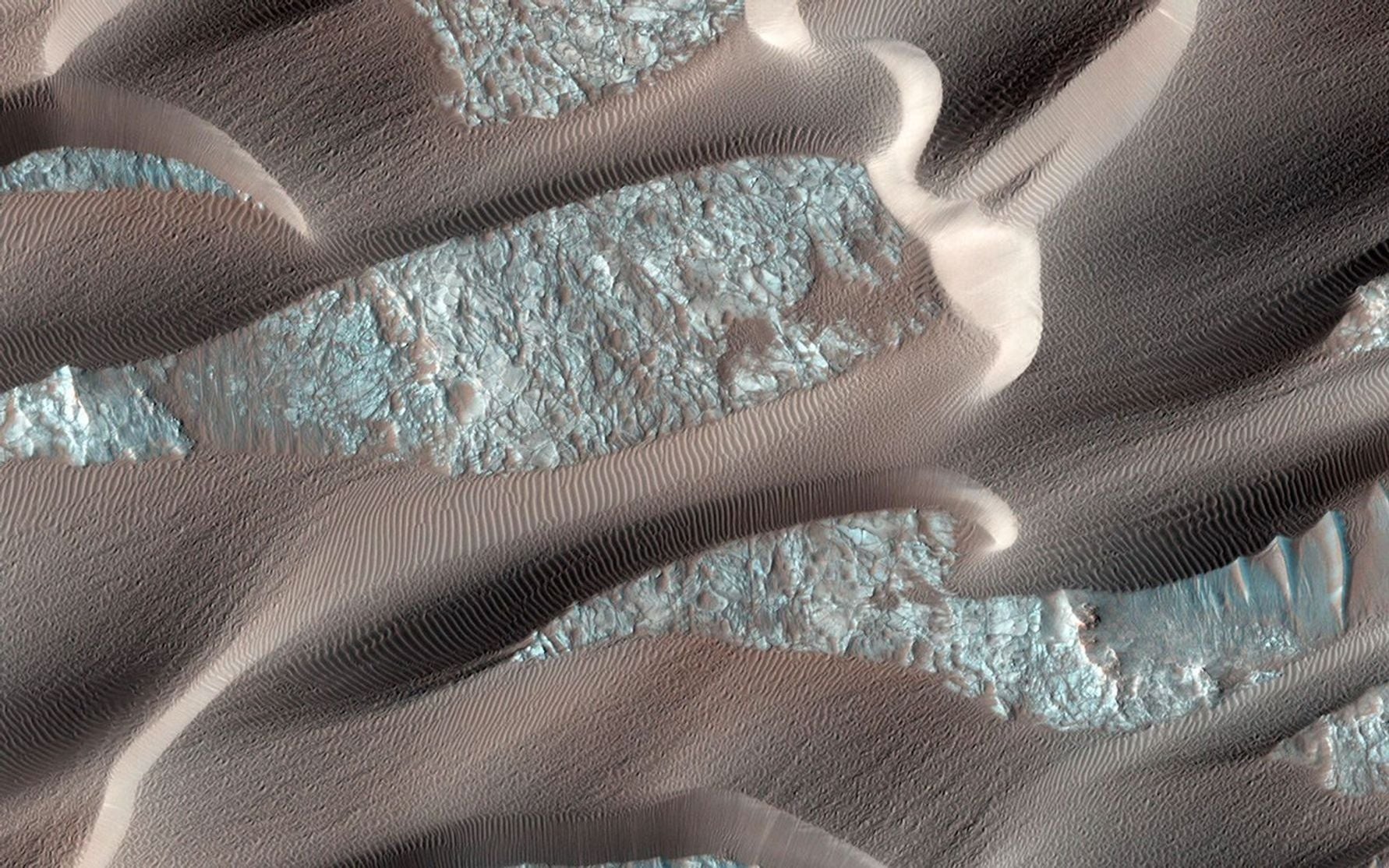 🚀Space
Photo: Universe Today
Key points
- Sand dunes on alien worlds function as wind speedometers
- Everyday moderate winds drive most sand transport, not rare storms
- New models will assist upcoming planetary missions like Dragonfly
A New Method for Decoding Alien Weather
Researchers at Stanford University have developed a method that transforms sand dunes from simple weather vanes into cosmic speedometers capable of measuring wind speeds on other worlds. For decades, planetary scientists have used dunes on Mars, Venus, Titan, and even Comet 67P/Churyumov-Gerasimenko primarily to determine wind direction. However, a new study published in the Proceedings of the National Academy of Sciences reveals a direct mathematical relationship between grain size and wind velocities across different planetary bodies.
The mechanics of wind-driven sand transport hold the key to this discovery. When airflow across a dune reaches a specific threshold velocity, individual grains begin bouncing along the surface in a process known as saltation. Each returning grain ejects surrounding particles into the air, initiating a self-sustaining cascade. A major debate among scientists was whether these vast geological formations were shaped primarily by rare, violent dust storms or by moderate, everyday winds common to these environments.
Dunes as Geological Climate Archives
Lead author M. Colin Marvin gathered wind speed data and grain measurements across twenty-four diverse dune fields, ranging from Utah to the Namib Sand Sea. The analysis revealed that the bulk of sand transport occurs when wind speeds are only slightly above the initial transport threshold. For instance, sand grains roughly 0.2 millimeters wide are predominantly moved by everyday winds blowing at 26 kilometers per hour. Computer simulations using the ReSCAL tool further validated these findings across various simulated planetary conditions.
These quantitative findings provide scientists with a robust new framework for reading geological history encoded in extraterrestrial landscapes. With upcoming interplanetary missions like NASA’s Dragonfly heading to Saturn’s moon Titan in the 2030s, researchers will be able to combine grain measurements with this new mathematical model. This approach enables the reconstruction of ancient wind histories on worlds where direct meteorological records remain elusive, opening a new chapter in comparative planetology.
Source Universe Today — universetoday.com/articles/tiny-grains-of-sand-act-as-cosmic-speedo… ↗
Read next
 📈Business
EU Budget Row: Macron Accuses Le Pen of Arrogance Amid Multiannual Funding Clash
Discussions over the European Union's next multiannual budget have sparked a fierce political showdown between French President Emmanuel Macron and far-right leader Marin…
 📈Business
Trump Administration Pressures Intel and Nvidia, Sparking Concerns Over State Control
Newly unsealed court documents reveal aggressive government pressure on Intel and Nvidia, shifting tech policy toward direct state stakes.
 🛡️Cyber
Russia’s hybrid war on Europe is evolving but failing to deter Ukraine support, IISS report says
A report by the IISS highlights an increase in Russian sabotage and infrastructure attacks across Europe, noting however that the strategy has failed to weaken support fo…
 🔬Science
Biomolecular analysis reveals centuries-old embalming recipes for Egyptian crocodile mummies
A study of ancient Egyptian crocodile mummies shows that embalmers used the exact same beeswax and pine resin recipe centuries apart at a single site.
 🛡️Cyber
Cybersecurity Weekly Roundup: Ransomware Fraud, ChatGPT Sites Leaks, and New Defenses
The latest threat intelligence roundup covers charges against a recovery firm co-founder, web app exposure risks, software patches, and VirusTotal's new detection feature…
 💻Tech
Astronomers Witness Rare Stellar Merger as Red Giant Devours Companion Star
An international team of researchers used advanced ground- and space-based telescopes to document a rare cosmic event where a massive red giant swallowed its smaller stel…