A Common Food Emulsifier Could Solve One of Rocketry’s Oldest Fuel Problems
Researchers at Concordia University have discovered that lecithin, a common food additive, can create a stable gel rocket propellant combining the best traits of solid and liquid fuels.
 🚀Space
Photo: Universe Today
Key points
- Lecithin acts as an organic gelling agent to stabilize kerosene rocket fuel.
- The gel undergoes shear thinning, turning into a pumpable liquid under pressure.
- The material demonstrated a stable shelf life of over one year in laboratory tests.
For decades, propulsion engineers have navigated a difficult trade-off between solid and liquid rocket propellants. While solid boosters offer durability and simple ignition, they cannot be throttled or shut down once ignited. Liquid fuels provide exceptional control, yet they slosh dangerously inside tanks in zero-gravity environments and tend to evaporate or leak during long-duration interplanetary missions. Gels have long been studied as a potential bridge between these two states, acting like dense solids in storage while flowing like liquids inside combustion chambers.
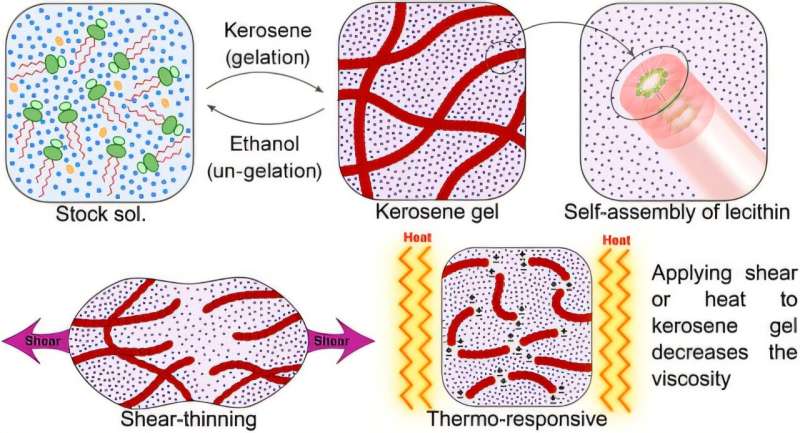
In a recent paper published in the journal Langmuir, Concordia researchers Pranay Mudaliar and Jerin John introduced an unconventional ingredient to tackle this challenge: lecithin. Commonly found on supermarket shelves as a food emulsifier used to keep chocolate and salad dressings smooth, lecithin functions as an organic gelling agent when combined with trace amounts of calcium chloride salt. The molecules self-assemble into microscopic worm-like micelles, forming a 3D mesh that traps kerosene molecules in place.
The material's standout feature is shear thinning. While resting in a tank, the fuel holds a firm gel shape, completely eliminating the sloshing issues inherent to liquid rockets. However, mechanical pressure from fuel lines causes the micellar mesh to collapse, dropping the viscosity by a factor of over one hundred and transforming the substance into a pumpable liquid. Because lecithin is made of carbon and hydrogen, it burns cleanly alongside the kerosene without adding non-combustible dead-weight.
Laboratory measurements also revealed a shelf life exceeding one year with no phase separation, alongside alternative triggers such as mild heating or ethanol exposure that can liquefy specific portions of the fuel. Despite these promising attributes, the propulsion concept still faces significant hurdles, including high-pressure injector tests and withstanding the extreme vibrations and thermal shocks of actual space launches.
Source Universe Today — universetoday.com/articles/a-common-food-emulsifier-could-solve-one… ↗
Read next
 📈Business
EU Budget Row: Macron Accuses Le Pen of Arrogance Amid Multiannual Funding Clash
Discussions over the European Union's next multiannual budget have sparked a fierce political showdown between French President Emmanuel Macron and far-right leader Marin…
 📈Business
Trump Administration Pressures Intel and Nvidia, Sparking Concerns Over State Control
Newly unsealed court documents reveal aggressive government pressure on Intel and Nvidia, shifting tech policy toward direct state stakes.
 🛡️Cyber
Russia’s hybrid war on Europe is evolving but failing to deter Ukraine support, IISS report says
A report by the IISS highlights an increase in Russian sabotage and infrastructure attacks across Europe, noting however that the strategy has failed to weaken support fo…
 🔬Science
Biomolecular analysis reveals centuries-old embalming recipes for Egyptian crocodile mummies
A study of ancient Egyptian crocodile mummies shows that embalmers used the exact same beeswax and pine resin recipe centuries apart at a single site.
 🛡️Cyber
Cybersecurity Weekly Roundup: Ransomware Fraud, ChatGPT Sites Leaks, and New Defenses
The latest threat intelligence roundup covers charges against a recovery firm co-founder, web app exposure risks, software patches, and VirusTotal's new detection feature…
 💻Tech
Astronomers Witness Rare Stellar Merger as Red Giant Devours Companion Star
An international team of researchers used advanced ground- and space-based telescopes to document a rare cosmic event where a massive red giant swallowed its smaller stel…