Google turns to Blue Origin for orbital data center launch in 2029
Google has partnered with Blue Origin to launch Project Suncatcher satellites in 2029, highlighting a broader long-term challenge regarding heavy-lift rocket dependency.
 🚀Space
Photo: Ars Technica
Key points
- Google will use Blue Origin's New Glenn rocket for a 2029 orbital data center demonstration.
- Project Suncatcher aims to leverage continuous orbital solar power for AI infrastructure.
- Long-term economic viability depends on heavy-lift launch costs dropping to $200 per kilogram.
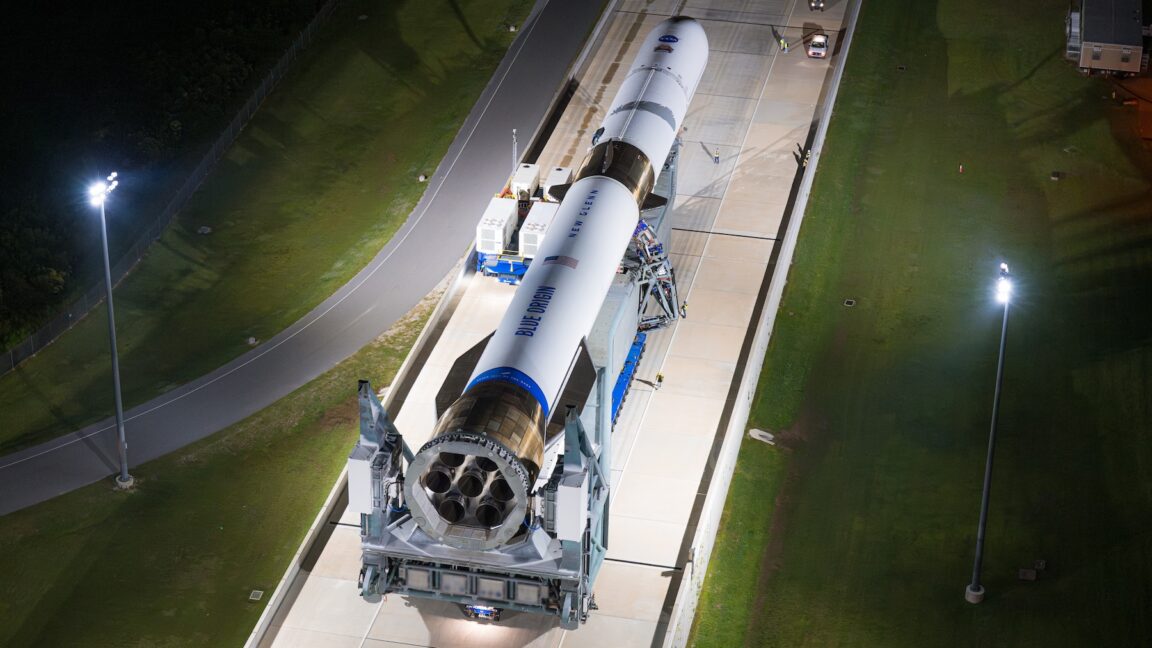
Google has taken a concrete step toward its orbital computing ambitions by securing a launch agreement with Blue Origin. Under the partnership, Blue Origin’s New Glenn rocket will deploy experimental data center satellites into a Sun-synchronous orbit in 2029 as part of the tech giant's Project Suncatcher initiative.
Navigating the Economics of Space Compute
First disclosed roughly a year ago, Project Suncatcher is a long-term research moonshot aimed at scaling artificial intelligence infrastructure in space by harnessing uninterrupted solar power. The upcoming 2029 mission will serve as a crucial technology demonstration, designed to test networked, solar-powered satellites equipped with advanced AI chips capable of handling machine-learning workloads in orbit.
However, the broader viability of maintaining large orbital data center constellations in the 2030s hinges on launch costs. Experts widely agree that space-based facilities cannot compete economically with terrestrial data centers without ultra-low-cost, heavy-lift capabilities dropping to around $200 per kilogram. While SpaceX's Starship is the primary vehicle projected to hit such metrics, SpaceX has strong incentives to prioritize its own competing payloads, leaving outside customers vulnerable.
Furthermore, Blue Origin is developing its own orbital data center constellation, Project Sunrise, raising questions about potential conflicts of interest and reliance on a competitor. Developing a super-heavy-lift rocket requires over a decade of engineering and billions in capital—as demonstrated by SpaceX's $15 billion investment. Consequently, Google faces a challenging strategic dilemma: depending on rivals, acquiring niche aerospace firms, or attempting to build a proprietary launch vehicle capability from scratch.
Source Ars Technica — arstechnica.com/space/2026/11/google-turns-to-blue-origin-for-a-rocket-… ↗
Read next
 🛡️Cyber
Russia’s hybrid war on Europe is evolving but failing to deter Ukraine support, IISS report says
A report by the IISS highlights an increase in Russian sabotage and infrastructure attacks across Europe, noting however that the strategy has failed to weaken support fo…
 🔬Science
Biomolecular analysis reveals centuries-old embalming recipes for Egyptian crocodile mummies
A study of ancient Egyptian crocodile mummies shows that embalmers used the exact same beeswax and pine resin recipe centuries apart at a single site.
 🛡️Cyber
Cybersecurity Weekly Roundup: Ransomware Fraud, ChatGPT Sites Leaks, and New Defenses
The latest threat intelligence roundup covers charges against a recovery firm co-founder, web app exposure risks, software patches, and VirusTotal's new detection feature…
 💻Tech
Astronomers Witness Rare Stellar Merger as Red Giant Devours Companion Star
An international team of researchers used advanced ground- and space-based telescopes to document a rare cosmic event where a massive red giant swallowed its smaller stel…
 🌍World
NATO Fighter Jets Scrambled After Drone Enters Latvian Airspace
Latvian armed forces deployed Alliance aircraft and interceptors following a brief border breach by an unidentified unmanned aerial vehicle.
 🔬Science
Bacterial colonies turn themselves inside out when oxygen is scarce
An international research team discovered that Neisseria gonorrhoeae bacteria respond to oxygen depletion in the colony's center by reducing cell adhesion, triggering a p…