Secrets of the Ice Giants: Are Uranus and Neptune Hiding Rocky Cores?
Astronomers propose using argon isotopes to determine the internal structure of Uranus and Neptune, potentially revealing hidden rocky surfaces.
 🚀Space
Photo: Universe Today
Key points
- Using argon-40 as a marker for rocky planetary cores
- Differentiating primordial gas from decay products via argon-36
- Preparation for the Uranus Orbiter mission in the 2040s
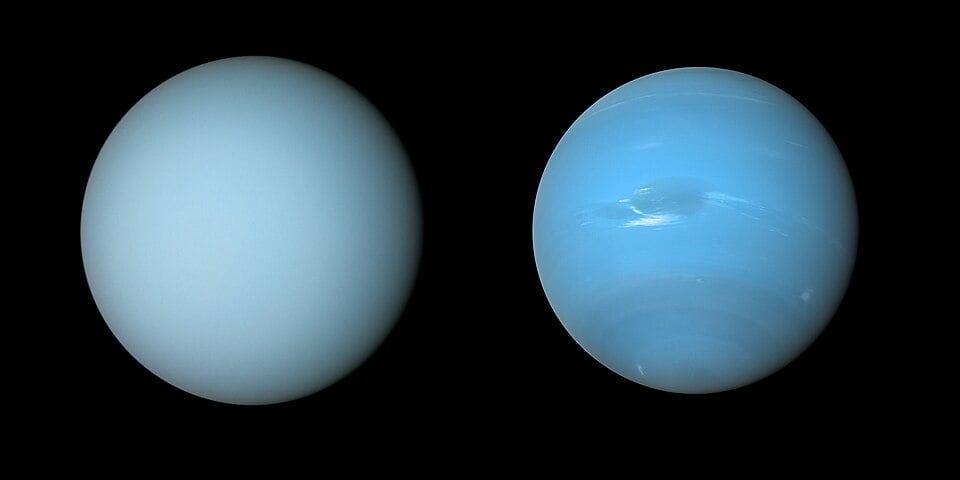
For decades, astronomers have classified Uranus and Neptune as "ice giants," distinguishing them from the gas giants Jupiter and Saturn. However, new research published in The Planetary Science Journal, led by Olivier Mousis of the Southwest Research Institute (SwRI), challenges this classification, suggesting that massive rocky formations may lie beneath their thick atmospheres.
The Argon Indicator Method
The key to solving this mystery may lie in argon-40, an inert gas produced by the radioactive decay of potassium-40 within rock. Scientists hypothesize that if this gas escapes from the planet's interior into the atmosphere, its concentration could serve as indirect evidence of a rocky core. This process is analogous to how radioactive decay in Earth's rocks contributes to the argon in our own atmosphere.
However, there is a complication: argon could have been trapped in the planets' atmospheres during their formation from the protosolar nebula. To distinguish "primordial" argon from that released by rocks, researchers propose comparing the concentration of argon-40 with its stable isotope, argon-36. This would act as a control group for estimating the planets' composition.
The upcoming Uranus Orbiter and Probe mission, slated for the 2040s, will be a critical step in testing these theoretical models. The data obtained will not only help refine the internal structure of the ice giants but also improve our understanding of planetary migration in the early solar system.
Source Universe Today — universetoday.com/articles/are-uranus-and-neptune-secretly-rock-gia… ↗
Read next
 🛡️Cyber
Russia’s hybrid war on Europe is evolving but failing to deter Ukraine support, IISS report says
A report by the IISS highlights an increase in Russian sabotage and infrastructure attacks across Europe, noting however that the strategy has failed to weaken support fo…
 🔬Science
Biomolecular analysis reveals centuries-old embalming recipes for Egyptian crocodile mummies
A study of ancient Egyptian crocodile mummies shows that embalmers used the exact same beeswax and pine resin recipe centuries apart at a single site.
 🛡️Cyber
Cybersecurity Weekly Roundup: Ransomware Fraud, ChatGPT Sites Leaks, and New Defenses
The latest threat intelligence roundup covers charges against a recovery firm co-founder, web app exposure risks, software patches, and VirusTotal's new detection feature…
 💻Tech
Astronomers Witness Rare Stellar Merger as Red Giant Devours Companion Star
An international team of researchers used advanced ground- and space-based telescopes to document a rare cosmic event where a massive red giant swallowed its smaller stel…
 🌍World
NATO Fighter Jets Scrambled After Drone Enters Latvian Airspace
Latvian armed forces deployed Alliance aircraft and interceptors following a brief border breach by an unidentified unmanned aerial vehicle.
 🔬Science
Bacterial colonies turn themselves inside out when oxygen is scarce
An international research team discovered that Neisseria gonorrhoeae bacteria respond to oxygen depletion in the colony's center by reducing cell adhesion, triggering a p…