NASA Captures M-Class Solar Flare: Potential Impacts on Earth and Space Operations
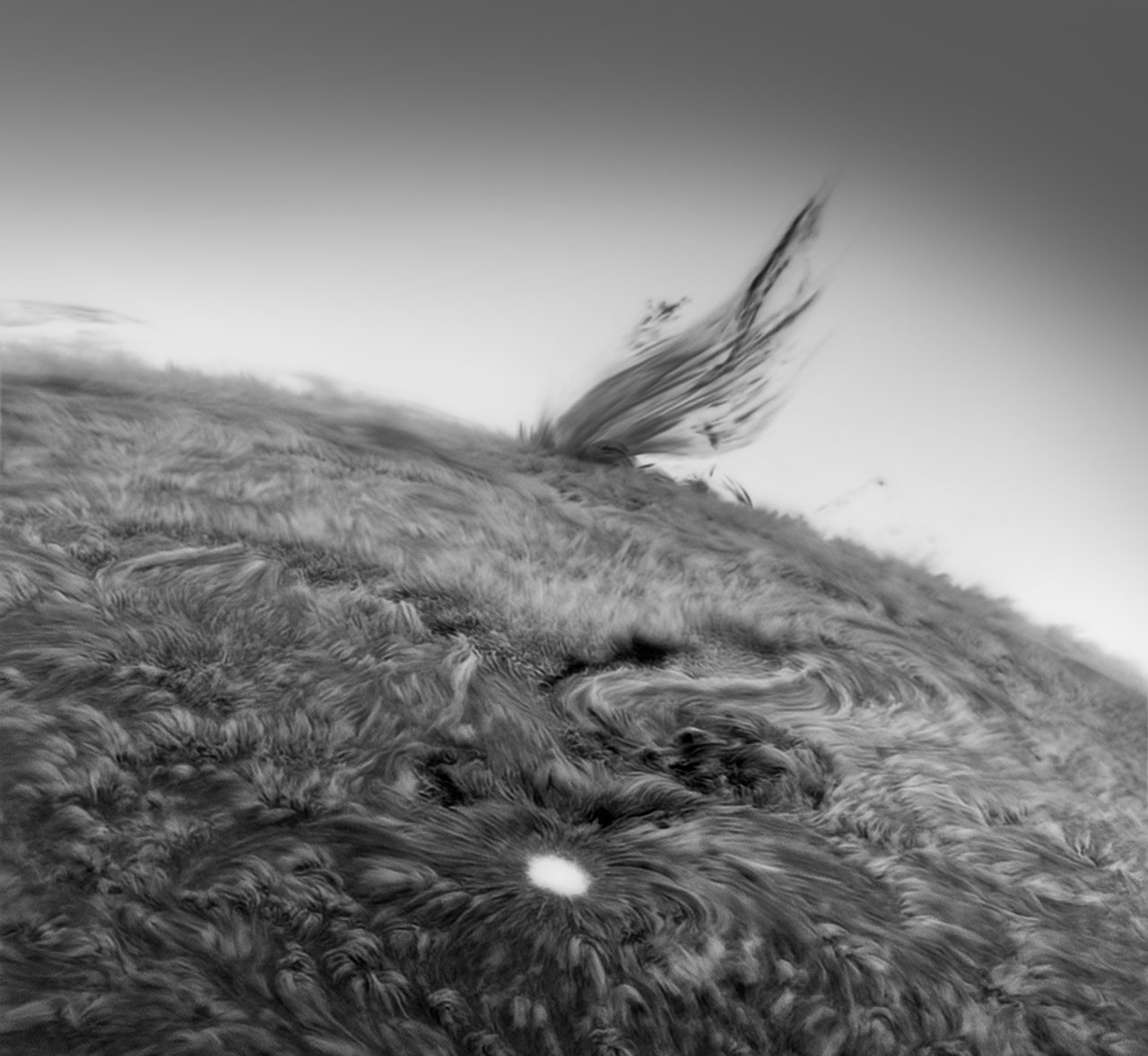
NASA published an image of the Sun's chromosphere featuring an M1-class solar flare driven by shifting magnetic fields.
 🚀Space
Photo: NASA News
Key points
- NASA captured an M1-class solar flare in the Sun's chromosphere
- The event resulted from twisted magnetic fields releasing energy
- M-class flares can cause polar radio blackouts and minor radiation storms
- NASA and NOAA continuously monitor solar activity to protect infrastructure
Dynamics of Solar Activity and the M1-Class Flare
NASA continues to highlight stellar phenomena through daily astronomical features, focusing attention on complex processes within the Sun's atmosphere. Researchers study the chromosphere—the layer above the solar surface where temperatures unexpectedly rise—to understand the underlying mechanisms. Scientists attribute this thermal behavior primarily to the energy generated by swirling and interacting magnetic fields extending through the solar atmosphere.
The featured image captures a dynamic energy release observed on May 14, 2025, using a specialized H-alpha filter sensitive to light emitted by energized hydrogen atoms. Based on observations from GOES spacecraft, this particular event was classified as an M1 flare, indicating a moderate level of brightness in X-ray emissions.
Implications for Space Weather and Infrastructure
Although M-class flares do not represent the most extreme category of solar explosions, they can still disrupt technological systems and orbital operations. Such events possess the capacity to trigger radio blackouts across Earth's polar regions and generate minor radiation storms that pose risks to astronauts operating outside protected environments.
Government agencies, including NASA and NOAA, maintain continuous surveillance of the Sun to forecast these hazardous episodes. Timely detection and warning systems allow operators to safeguard critical space infrastructure, communication satellites, and human crews from unexpected radiation hazards.
Source NASA News — science.nasa.gov/image-article/apod-2026-november-18-an-m-class-solar-f… ↗
Read next
 🛡️Cyber
Russia’s hybrid war on Europe is evolving but failing to deter Ukraine support, IISS report says
A report by the IISS highlights an increase in Russian sabotage and infrastructure attacks across Europe, noting however that the strategy has failed to weaken support fo…
 🔬Science
Biomolecular analysis reveals centuries-old embalming recipes for Egyptian crocodile mummies
A study of ancient Egyptian crocodile mummies shows that embalmers used the exact same beeswax and pine resin recipe centuries apart at a single site.
 🛡️Cyber
Cybersecurity Weekly Roundup: Ransomware Fraud, ChatGPT Sites Leaks, and New Defenses
The latest threat intelligence roundup covers charges against a recovery firm co-founder, web app exposure risks, software patches, and VirusTotal's new detection feature…
 💻Tech
Astronomers Witness Rare Stellar Merger as Red Giant Devours Companion Star
An international team of researchers used advanced ground- and space-based telescopes to document a rare cosmic event where a massive red giant swallowed its smaller stel…
 🌍World
NATO Fighter Jets Scrambled After Drone Enters Latvian Airspace
Latvian armed forces deployed Alliance aircraft and interceptors following a brief border breach by an unidentified unmanned aerial vehicle.
 🔬Science
Bacterial colonies turn themselves inside out when oxygen is scarce
An international research team discovered that Neisseria gonorrhoeae bacteria respond to oxygen depletion in the colony's center by reducing cell adhesion, triggering a p…