Computer Simulations Provide the Best Explanation Yet for Early Universe's 'Little Red Dots'
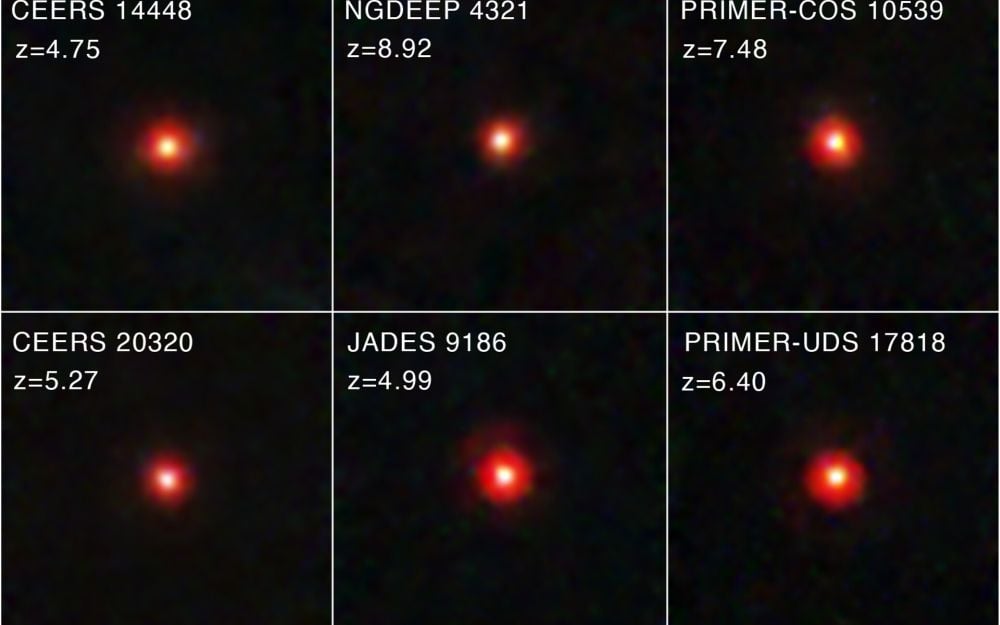
An international team of astronomers has used advanced cosmological simulations to decode the mystery of the 'Little Red Dots' discovered by the James Webb Space Telescope.
 🚀Space
Photo: Universe Today
Key points
- JWST observations revealed an abundance of compact, bright 'Little Red Dots' in the early universe.
- Previous formation theories struggled with environmental and physical constraints.
- New simulations attribute LRDs to black holes formed from collapsed supermassive primordial stars.
When the James Webb Space Telescope captured deep fields of the early universe, astronomers were surprised by the presence of numerous compact galaxies. Because of their distinct color and brightness, scientists dubbed them 'Little Red Dots' (LRDs). Their extreme abundance less than a billion years after the Big Bang challenged existing cosmological frameworks. Previous attempts to explain them through early quasars or direct collapse black holes left critical theoretical questions unanswered.
Unlocking the Mystery with Advanced Simulations
To solve this puzzle, a team led by Dr. Daniel Whalen from the University of Portsmouth utilized sophisticated cosmological simulations. The international collaboration included researchers from institutions in the United Arab Emirates, Greece, the United Kingdom, and the United States. Their findings were published in The Astrophysical Journal Letters.
The new simulations suggest that these enigmatic objects are galaxies powered by massive black holes born from the collapse of supermassive primordial stars. According to the model, these black holes are heavily veiled within dense discs of gas. This gaseous envelope traps high-energy X-rays while allowing infrared and visible light to escape, perfectly matching the unusual light signatures recorded by the Webb telescope.
Source Universe Today — universetoday.com/articles/computer-simulations-provide-the-best-ex… ↗
Read next
 🛡️Cyber
Russia’s hybrid war on Europe is evolving but failing to deter Ukraine support, IISS report says
A report by the IISS highlights an increase in Russian sabotage and infrastructure attacks across Europe, noting however that the strategy has failed to weaken support fo…
 🔬Science
Biomolecular analysis reveals centuries-old embalming recipes for Egyptian crocodile mummies
A study of ancient Egyptian crocodile mummies shows that embalmers used the exact same beeswax and pine resin recipe centuries apart at a single site.
 🛡️Cyber
Cybersecurity Weekly Roundup: Ransomware Fraud, ChatGPT Sites Leaks, and New Defenses
The latest threat intelligence roundup covers charges against a recovery firm co-founder, web app exposure risks, software patches, and VirusTotal's new detection feature…
 💻Tech
Astronomers Witness Rare Stellar Merger as Red Giant Devours Companion Star
An international team of researchers used advanced ground- and space-based telescopes to document a rare cosmic event where a massive red giant swallowed its smaller stel…
 🌍World
NATO Fighter Jets Scrambled After Drone Enters Latvian Airspace
Latvian armed forces deployed Alliance aircraft and interceptors following a brief border breach by an unidentified unmanned aerial vehicle.
 🔬Science
Bacterial colonies turn themselves inside out when oxygen is scarce
An international research team discovered that Neisseria gonorrhoeae bacteria respond to oxygen depletion in the colony's center by reducing cell adhesion, triggering a p…