Escaping Gases Ripped Apart a Comet, Boosting Its Brightness Thousands of Times
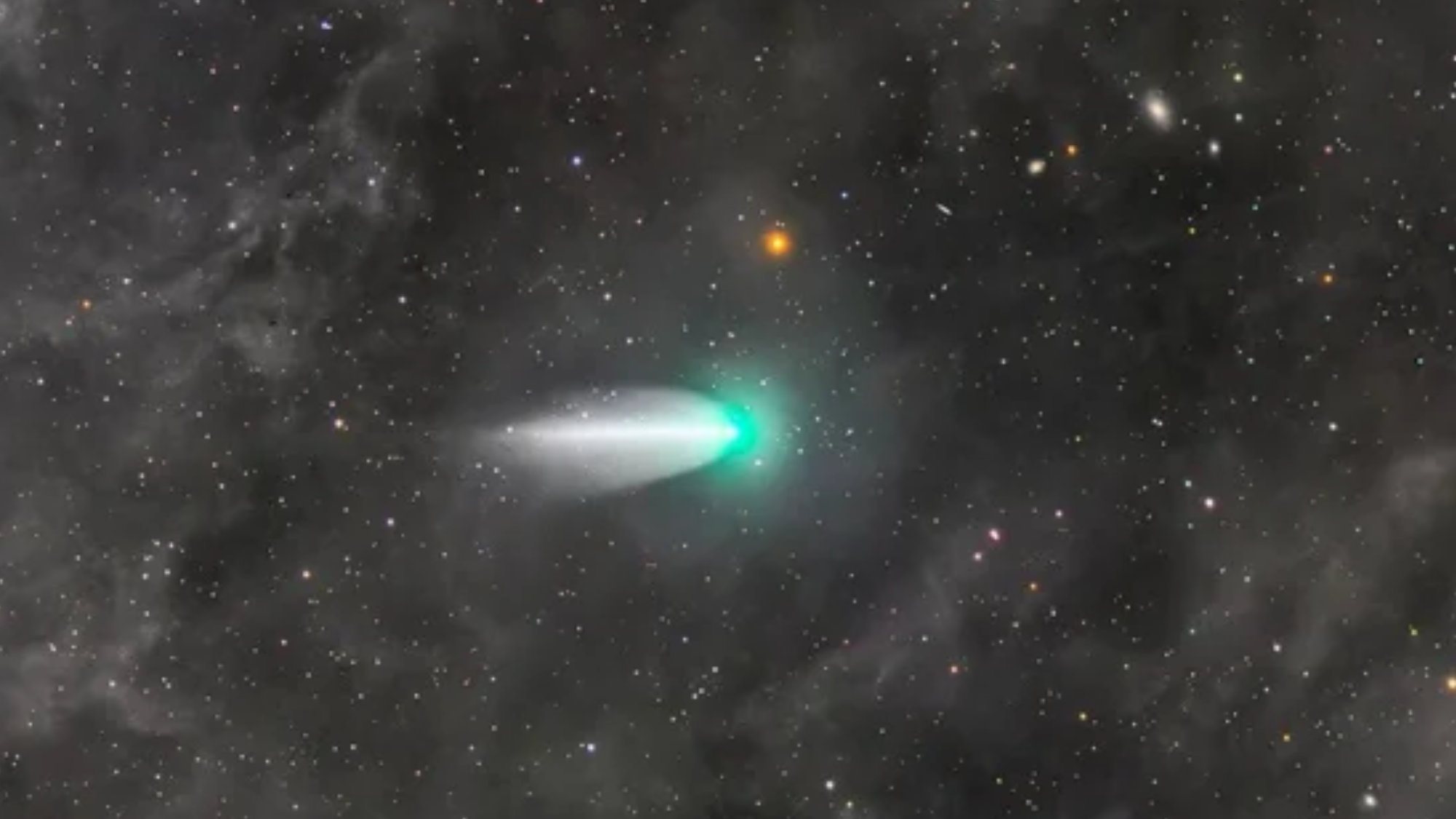
Comet 220P/McNaught experienced dramatic outbursts as solar heat vaporized subsurface ices, spewing massive amounts of dust into space.
 🚀Space
Photo: Space.com
Key points
- Comet 220P/McNaught brightened dramatically due to violent sub-surface gas jets.
- Solar heating caused volatile ices to sublimate, rupturing the comet's crust.
- The object is a Jupiter-family comet with a 5.5-year orbital period.
This summer, periodic comet 220P/McNaught captured the attention of astronomers following a series of dramatic and unexpected outbursts. The celestial body, usually too faint to be observed with standard amateur equipment, suddenly surged in brightness by thousands of times due to intense sub-surface activity.
As the comet headed toward perihelion, solar radiation began heating volatile ices hidden beneath its dusty crust. The rapid sublimation of water, carbon dioxide, and nitrogen into expanding gases generated immense internal pressure. This pressure ultimately fractured the comet's surface, ejecting massive quantities of fine dust into space.
"We have concluded that the comet detached localized parts of its crust, creating a dust-rich envelope," said Josep M. Trigo-Rodríguez of the Institute of Space Studies of Catalonia.
Classified as a Jupiter-family comet with a 5.5-year orbit, 220P originates from the distant Kuiper Belt and Scattered Disk regions before being gravitationally captured. Studying these explosive events offers critical insight into the structural integrity and volatile composition of such unique celestial bodies.
Source Space.com — space.com/astronomy/comets/how-escaping-gases-ripped-apart-a-comet-… ↗
Read next
 📈Business
Trump Administration Pressures Intel and Nvidia, Sparking Concerns Over State Control
Newly unsealed court documents reveal aggressive government pressure on Intel and Nvidia, shifting tech policy toward direct state stakes.
 🛡️Cyber
Russia’s hybrid war on Europe is evolving but failing to deter Ukraine support, IISS report says
A report by the IISS highlights an increase in Russian sabotage and infrastructure attacks across Europe, noting however that the strategy has failed to weaken support fo…
 🔬Science
Biomolecular analysis reveals centuries-old embalming recipes for Egyptian crocodile mummies
A study of ancient Egyptian crocodile mummies shows that embalmers used the exact same beeswax and pine resin recipe centuries apart at a single site.
 🛡️Cyber
Cybersecurity Weekly Roundup: Ransomware Fraud, ChatGPT Sites Leaks, and New Defenses
The latest threat intelligence roundup covers charges against a recovery firm co-founder, web app exposure risks, software patches, and VirusTotal's new detection feature…
 💻Tech
Astronomers Witness Rare Stellar Merger as Red Giant Devours Companion Star
An international team of researchers used advanced ground- and space-based telescopes to document a rare cosmic event where a massive red giant swallowed its smaller stel…
 🌍World
NATO Fighter Jets Scrambled After Drone Enters Latvian Airspace
Latvian armed forces deployed Alliance aircraft and interceptors following a brief border breach by an unidentified unmanned aerial vehicle.