Curiosity Completes Nazca Drilling Campaign, Investigating Unique Crystal Formations
NASA's Curiosity rover has finished its work at the Nazca site, analyzing unusual disk-shaped crystals and capturing a solar eclipse by Phobos before moving south.
 🚀Space
Photo: NASA Breaking News
Key points
- Curiosity finished drilling and sample delivery at the Nazca site
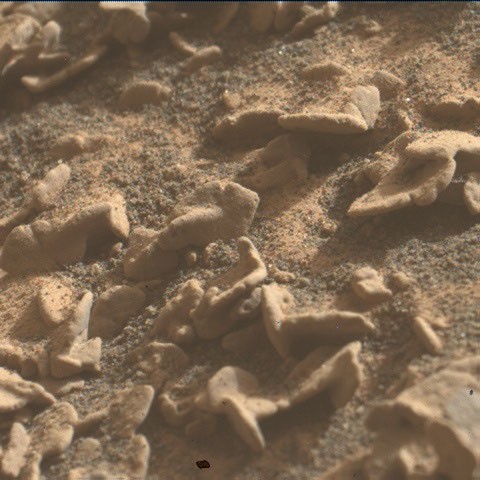
- Rover investigated unique 'chip-shaped' crystal formations in bedrock
- Environmental tasks included Phobos eclipse imaging and dust devil surveys
NASA’s Curiosity rover has concluded its latest drilling campaign at the "Nazca" site, focusing on a unique geological feature characterized by disk-shaped mineral crystals. During Sols 5063 to 5069, the robotic explorer successfully delivered pulverized rock samples to the Sample Analysis at Mars (SAM) instrument for detailed chemical evaluation. This mission phase aimed to decode the origin of these "chip-like" formations found within the Martian bedrock.
Scientific Observations and Imaging
While the SAM instrument processed the samples, the mission team utilized the ChemCam and Mastcam suites to conduct extensive secondary research. Laser-induced breakdown spectroscopy (LIBS) was performed on several targets, including the "Ahi Veremos," "Colca," and "Bermejo" crystal forms. These observations provide a depth profile of the mineral composition, while high-resolution mosaics captured the surrounding landscape, including the "Cordillera" and "Mishe Mokwa" ridges.
Beyond geology, Curiosity monitored the Martian environment, recording dust devil activity and atmospheric movies. A significant event during this period was the solar eclipse caused by Mars' moon, Phobos, which the rover prioritized for imaging. Additionally, the team employed the MAHLI camera’s ultraviolet and white-light LEDs for rare nighttime photography of the crystal structures, offering a different perspective on their reflective properties.
With the Nazca objectives met, Curiosity has begun its journey southward. The rover is now navigating back toward its primary exploration route, continuing its long-term ascent of Mount Sharp to investigate the planet’s habitability and geological history.
Source NASA Breaking News — science.nasa.gov/blog/curiosity-blog-sols-5063-5069-rocks-and-chips/ ↗
Read next
 📈Business
Trump Administration Pressures Intel and Nvidia, Sparking Concerns Over State Control
Newly unsealed court documents reveal aggressive government pressure on Intel and Nvidia, shifting tech policy toward direct state stakes.
 🛡️Cyber
Russia’s hybrid war on Europe is evolving but failing to deter Ukraine support, IISS report says
A report by the IISS highlights an increase in Russian sabotage and infrastructure attacks across Europe, noting however that the strategy has failed to weaken support fo…
 🔬Science
Biomolecular analysis reveals centuries-old embalming recipes for Egyptian crocodile mummies
A study of ancient Egyptian crocodile mummies shows that embalmers used the exact same beeswax and pine resin recipe centuries apart at a single site.
 🛡️Cyber
Cybersecurity Weekly Roundup: Ransomware Fraud, ChatGPT Sites Leaks, and New Defenses
The latest threat intelligence roundup covers charges against a recovery firm co-founder, web app exposure risks, software patches, and VirusTotal's new detection feature…
 💻Tech
Astronomers Witness Rare Stellar Merger as Red Giant Devours Companion Star
An international team of researchers used advanced ground- and space-based telescopes to document a rare cosmic event where a massive red giant swallowed its smaller stel…
 🌍World
NATO Fighter Jets Scrambled After Drone Enters Latvian Airspace
Latvian armed forces deployed Alliance aircraft and interceptors following a brief border breach by an unidentified unmanned aerial vehicle.