Dwarf Galaxies Like NGC 4449 Act as Cosmic Seeders of Heavy Elements
New observations of the dwarf galaxy NGC 4449 reveal that small galactic systems are surprisingly efficient at dispersing oxygen and other heavy elements throughout the universe.
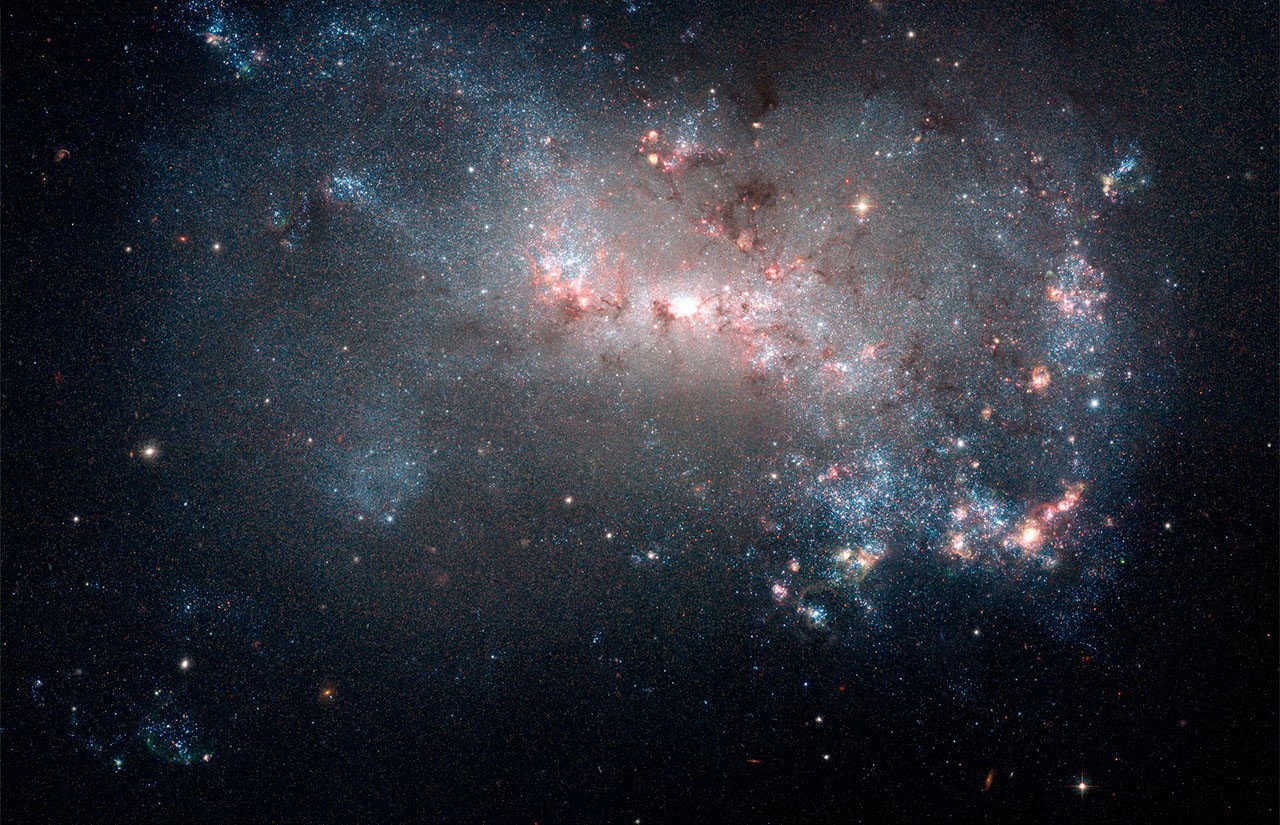 🚀Space
Photo: NASA News
Key points
- NGC 4449 is 10 times smaller than the Milky Way but represents the universe's most common galaxy type.
- Stellar winds and supernovae are highly efficient at ejecting heavy elements from dwarf galaxies.
- These systems act as primary sources for the oxygen and heavy elements found in intergalactic space.
Despite their modest size, dwarf galaxies may be the primary engines for distributing the chemical building blocks of life across the cosmos. Recent data from the Hubble Space Telescope focusing on NGC 4449 suggests these systems are far more influential than their star counts imply.
Size vs. Impact
NGC 4449 is roughly one-tenth the diameter of the Milky Way, spanning about 10,000 light-years. While our home galaxy contains hundreds of billions of stars, NGC 4449 hosts only a few billion. However, dwarf galaxies represent the most numerous class of galaxies in the observable universe, making their collective impact significant.
The Oxygen Mystery
Astronomers have noted a discrepancy between theoretical models and observed chemical compositions in these small systems. Specifically, NGC 4449 lacks the expected amounts of oxygen. This "missing" matter indicates that internal processes, such as powerful stellar winds and supernova explosions, are exceptionally effective at ejecting heavy elements into the surrounding intergalactic medium.
Building Blocks of the Universe
This discovery highlights the role of dwarf galaxies as cosmic distributors. By blowing away the elements forged in their stars, they provide the necessary materials for the formation of future stars, planets, and potentially biological life in the vast reaches of space. It turns out that these tiny systems play a massive role in enriching the void between galaxies with the essential ingredients for complexity.
Source NASA News — science.nasa.gov/image-article/apod-2026-november-11-ngc-4449-small-gal… ↗
Read next
 📈Business
Trump Administration Pressures Intel and Nvidia, Sparking Concerns Over State Control
Newly unsealed court documents reveal aggressive government pressure on Intel and Nvidia, shifting tech policy toward direct state stakes.
 🛡️Cyber
Russia’s hybrid war on Europe is evolving but failing to deter Ukraine support, IISS report says
A report by the IISS highlights an increase in Russian sabotage and infrastructure attacks across Europe, noting however that the strategy has failed to weaken support fo…
 🔬Science
Biomolecular analysis reveals centuries-old embalming recipes for Egyptian crocodile mummies
A study of ancient Egyptian crocodile mummies shows that embalmers used the exact same beeswax and pine resin recipe centuries apart at a single site.
 🛡️Cyber
Cybersecurity Weekly Roundup: Ransomware Fraud, ChatGPT Sites Leaks, and New Defenses
The latest threat intelligence roundup covers charges against a recovery firm co-founder, web app exposure risks, software patches, and VirusTotal's new detection feature…
 💻Tech
Astronomers Witness Rare Stellar Merger as Red Giant Devours Companion Star
An international team of researchers used advanced ground- and space-based telescopes to document a rare cosmic event where a massive red giant swallowed its smaller stel…
 🌍World
NATO Fighter Jets Scrambled After Drone Enters Latvian Airspace
Latvian armed forces deployed Alliance aircraft and interceptors following a brief border breach by an unidentified unmanned aerial vehicle.