Tiny Solar Whirlpools May Explain the Sun’s Blistering Corona
Research suggests that millions of microscopic plasma vortices on the Sun’s surface act as the engine driving the heating of its outer atmosphere.
 🚀Space
Photo: Universe Today
Key points
- Millions of plasma vortices identified on the solar surface.
- Kelvin-Helmholtz waves convert mechanical energy into magnetic stress.
- Magnetic reconnection heats the corona due to low particle density.
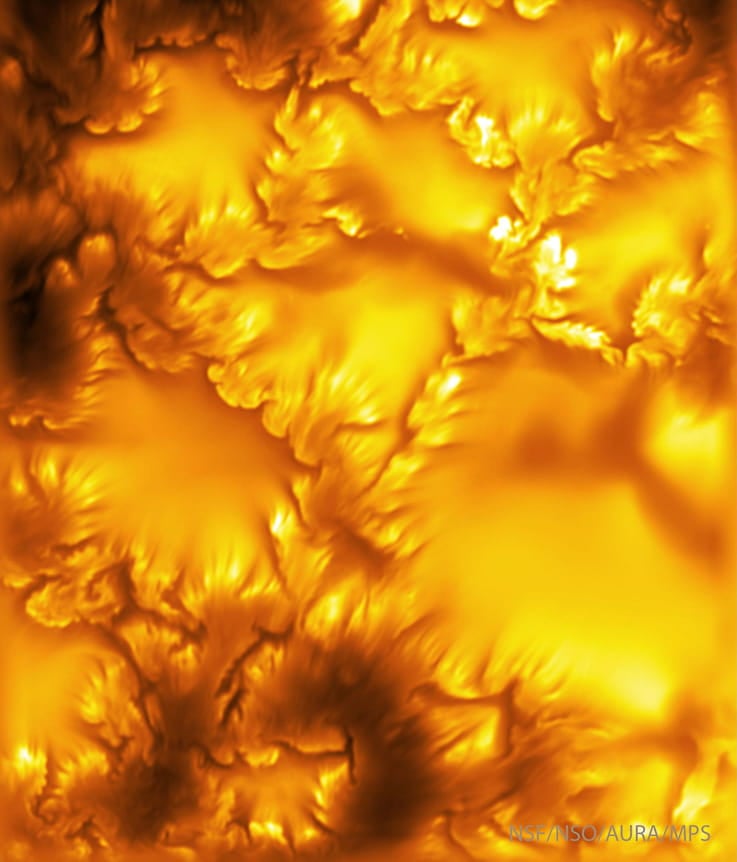
Scientists have identified a potential mechanism to solve a long-standing mystery in solar physics: why the Sun’s corona is significantly hotter than its surface. A study by Katariina Nykyri of Embry-Riddle, published in The Astrophysical Journal Letters, argues that millions of microscopic plasma whirlpools are the primary drivers of this temperature discrepancy.
Using high-resolution imagery from the Daniel K. Inouye Solar Telescope (DKIST), researchers were able to observe vortices driven by Kelvin-Helmholtz waves. These structures form when fast-moving plasma interacts with slower, magnetized plasma, accumulating substantial mechanical energy. As these vortices churn, they transfer kinetic energy into the Sun’s magnetic fields.
Calculations indicate that each vortex contains approximately two septillion ergs of energy. When these vortices dissipate, they compress magnetic field lines, triggering a process known as magnetic reconnection. This process releases energy that heats the coronal plasma. Because particle density in the corona is much lower than on the surface, the released energy results in a significantly higher temperature increase for individual atoms.
Source Universe Today — universetoday.com/articles/tiny-solar-whirlpools-may-hold-the-secre… ↗
Read next
 📈Business
Trump Administration Pressures Intel and Nvidia, Sparking Concerns Over State Control
Newly unsealed court documents reveal aggressive government pressure on Intel and Nvidia, shifting tech policy toward direct state stakes.
 🛡️Cyber
Russia’s hybrid war on Europe is evolving but failing to deter Ukraine support, IISS report says
A report by the IISS highlights an increase in Russian sabotage and infrastructure attacks across Europe, noting however that the strategy has failed to weaken support fo…
 🔬Science
Biomolecular analysis reveals centuries-old embalming recipes for Egyptian crocodile mummies
A study of ancient Egyptian crocodile mummies shows that embalmers used the exact same beeswax and pine resin recipe centuries apart at a single site.
 🛡️Cyber
Cybersecurity Weekly Roundup: Ransomware Fraud, ChatGPT Sites Leaks, and New Defenses
The latest threat intelligence roundup covers charges against a recovery firm co-founder, web app exposure risks, software patches, and VirusTotal's new detection feature…
 💻Tech
Astronomers Witness Rare Stellar Merger as Red Giant Devours Companion Star
An international team of researchers used advanced ground- and space-based telescopes to document a rare cosmic event where a massive red giant swallowed its smaller stel…
 🌍World
NATO Fighter Jets Scrambled After Drone Enters Latvian Airspace
Latvian armed forces deployed Alliance aircraft and interceptors following a brief border breach by an unidentified unmanned aerial vehicle.