Uzbekistan Overhauls Agriculture with Smart Tech and Green Finance to Reach $10B Export Goal
Uzbekistan is implementing a comprehensive agricultural reform focused on high-yield farming, precision irrigation, and foreign investments to address critical water scarcity and boost exports.
 📈Business
Photo: Euronews
Key points
- Uzbekistan targets $10 billion in food exports by 2030 through agricultural innovation.
- A $200 million World Bank project aims to save 540 million cubic meters of water annually.
- Modern high-density orchards and agricultural drones are significantly increasing crop yields.
Agriculture remains a vital pillar of Uzbekistan's economy, yet the sector faces increasing pressure to boost output while coping with strict land and water constraints. In response, the government has launched a series of technological initiatives, designating 2026–2030 as a priority period for food security. Agriculture Minister Ibrokhim Abdurakhmonov noted that the country currently produces about 26 million tonnes of fruit and vegetables annually for 92 export markets, with a target to reach $10 billion in food exports by 2030.
Yield Optimization Over Land Expansion
The core strategy focuses on expanding research and innovation rather than clearing more farmland. Shamshod Ergashev, Head of the Minister's Secretariat, reported that cotton cultivation areas were reduced to roughly 875,600 hectares in 2025 from over one million hectares in previous years, yet yields reached nearly four million tonnes. Furthermore, Uzbekistan harvested 10 million tonnes of grain in 2026 due to improved seed treatments and modern planting techniques.
Out of 572,600 hectares of existing orchards and vineyards, the state plans to establish 172,000 hectares of high-density orchards between 2026 and 2028.
"Traditional orchards used to produce seven to ten tonnes of fruit per hectare. Now, with trees grown on dwarf and semi-dwarf rootstocks, we are achieving 30 to 35 tonnes, and in some cases even 50 to 60 tonnes," stated Abror Jo'rayev, Head of the Republican Horticulture Development Department.
Financial Support and Water Infrastructure
To support farmers, the government offers preferential loans of up to 120 million soums (approx. €8,873) per hectare with a seven-year term, alongside three-year maintenance subsidies. With agriculture accounting for roughly 90% of national water use according to the World Bank, efficient irrigation is paramount. In May 2025, the World Bank approved a $200 million project to modernize irrigation networks across five regions, aiming to curb annual water losses by 540 million cubic meters.
Digital Tools and International Financing
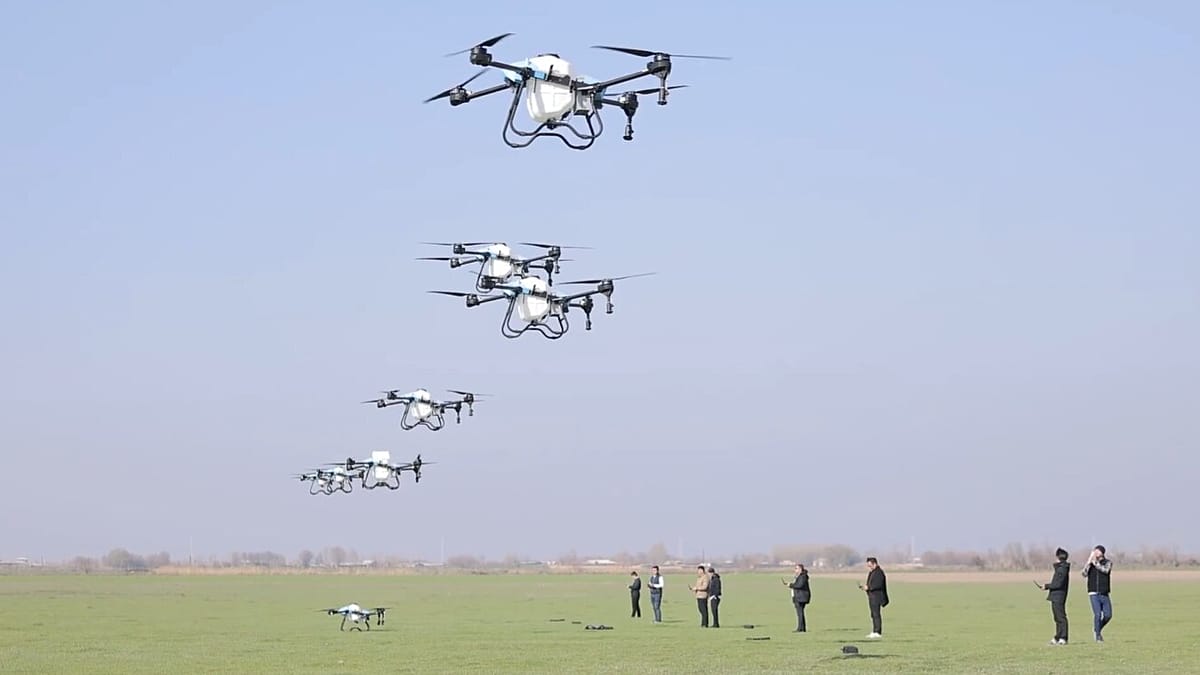
Technological upgrades in 2026 included 100 Chinese agricultural drones deployed for farmland monitoring and targeted spraying, alongside AI applications for crop forecasting and digital management portals like Agroportal and Agrosubsidy.
- The Global Green Growth Institute (GGGI) facilitated the issuance of green bonds by Uzbek commercial banks on the London Stock Exchange;
- An agrifood investment platform with the EBRD aims to mobilize around $1.5 billion for the sector;
- Despite progress, Uzbekistan remains reliant on imports for essential staples such as sugar and vegetable oil.
Source Euronews — euronews.com/2026/11/10/inside-uzbekistans-agricultural-transformat… ↗
Read next
 🚀Space
Ukraine braces for another difficult winter amid ongoing attacks on energy infrastructure
Ukrainians are preparing for a harsh winter as continuous strikes on energy facilities and rising food prices strain households.
 🛡️Cyber
Russia’s hybrid war on Europe is evolving but failing to deter Ukraine support, IISS report says
A report by the IISS highlights an increase in Russian sabotage and infrastructure attacks across Europe, noting however that the strategy has failed to weaken support fo…
 🔬Science
Biomolecular analysis reveals centuries-old embalming recipes for Egyptian crocodile mummies
A study of ancient Egyptian crocodile mummies shows that embalmers used the exact same beeswax and pine resin recipe centuries apart at a single site.
 🛡️Cyber
Cybersecurity Weekly Roundup: Ransomware Fraud, ChatGPT Sites Leaks, and New Defenses
The latest threat intelligence roundup covers charges against a recovery firm co-founder, web app exposure risks, software patches, and VirusTotal's new detection feature…
 💻Tech
Astronomers Witness Rare Stellar Merger as Red Giant Devours Companion Star
An international team of researchers used advanced ground- and space-based telescopes to document a rare cosmic event where a massive red giant swallowed its smaller stel…
 🌍World
NATO Fighter Jets Scrambled After Drone Enters Latvian Airspace
Latvian armed forces deployed Alliance aircraft and interceptors following a brief border breach by an unidentified unmanned aerial vehicle.